
FB S5.4 Stories On Skin Student Workbook
$19.99
(No reviews yet)

Write a Review

FB S5.4 Stories On Skin Student Workbook
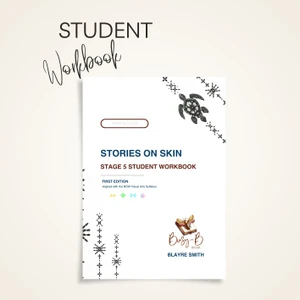
Stories on Skin – Student Workbook
Body adornment, identity, culture, symbolism, faith and visual storytelling through art and writing.
The Stories on Skin Student Workbook is a 10-week Visual Arts resource aligned with the NSW Stage 5 Visual Arts Syllabus, supporting students as they investigate body adornment practices across cultures. Through the study of Aboriginal body painting, Samoan Tatau (Malu), Mehndi (Henna), and Modern Western Tattooing, students explore how people use visual symbols, patterns and designs to communicate identity, beliefs, status, relationships, stories and cultural values.
Through this workbook, students will:
- Investigate a range of body adornment practices, exploring their purposes, meanings, symbols and significance.
- Explore the practices of individuals and communities, examining how identity, beliefs, traditions and experiences shape body adornment practices.
- Develop their understanding of the Artworld Concept World, considering how cultural, historical, spiritual and personal contexts influence artistic expression and visual communication.
- Create a realistic hand drawing and an original body adornment-inspired design that transforms Zentangle patterns into contemporary visual artworks.
- Experiment with drawing, pattern-making, symbolism and digital technologies (extension activities) to develop creative and technical skills.
- Analyse how body adornment is used to communicate identity, belonging, status, beliefs and personal stories across different cultures and societies.
- Develop writing skills by researching, planning and composing a newspaper article that explores the cultural significance of a chosen body adornment tradition.
- Reflect on the Christian belief that every person is uniquely created and valued by God, considering how identity, purpose and belonging influence the ways people express themselves.
- Connect creativity with faith by exploring how visual symbols, stories and artistic traditions can communicate meaning, celebrate diversity and encourage respect for others.
This syllabus-aligned workbook embeds:
- NESA syllabus verbs to develop students' ability to identify, investigate and explain.
- Super 6 comprehension strategies to strengthen visual and written literacy.
- TEEL paragraph structures to scaffold cultural investigations and extended written responses.
- Newspaper article scaffolds to support research, information gathering, structure and journalistic writing.
- Integration of ICT tasks to support research and digital artmaking.
- Learning Intentions and Success Criteria throughout the unit to support student ownership of learning.
- VAPD scaffolding to support research, experimentation, design development, reflection and evaluation.
- Faith connections that encourage students to consider identity, belonging, respect, empathy, cultural understanding and the value of all people as part of God's creation.
Designed to reduce teacher workload while maximising student engagement, Stories on Skin develops practical, conceptual and reflective skills through cultural investigation, drawing, design-making, visual literacy and critical thinking. Students investigate how visual symbols and patterns communicate meaning, explore how culture and experience influence universal human practices, and create artworks inspired by body adornments from around the world.
Throughout the unit, students are encouraged to consider how body adornment can communicate stories, identity and belonging while developing respect for diverse cultural traditions and perspectives. By engaging with the Artworld concepts of Artist, Artwork, Audience and World, students examine how visual culture reflects the experiences, beliefs and values of individuals and communities, while developing skills in visual arts practice, research, written communication and creative expression.
Students are also invited to reflect on the Christian understanding that every individual is created with purpose and worth. Through discussion and reflection activities, they consider how art can celebrate identity, foster understanding between cultures and encourage appreciation for the diversity and uniqueness of God's creation.